| | | | Dear ,
Happy March from Blue Zones™ Health! This month we're recognizing National Kidney Month and Colorectal Cancer Awareness Month, two conditions where lifestyle factors and early detection make a measurable difference in outcomes. We have new patient resources for both, an expanded virtual class lineup including a new instructor, and a new recurring section on coding and quality that we think you'll find useful.
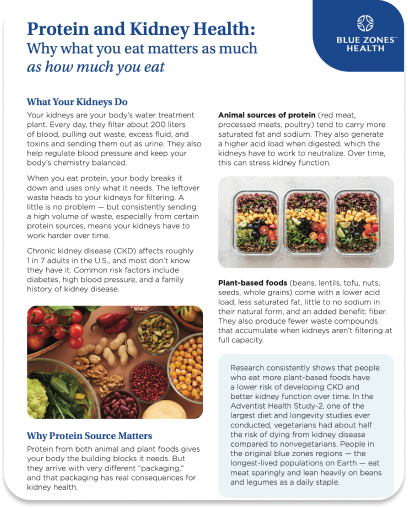
| | | | | | National Kidney Month: Patient Handout |
To support your patient conversations this month, we've developed a one-page kidney health handout covering what the kidneys do, why protein source matters, and specific food swaps patients can make right away. Print it, display it, or share it digitally.
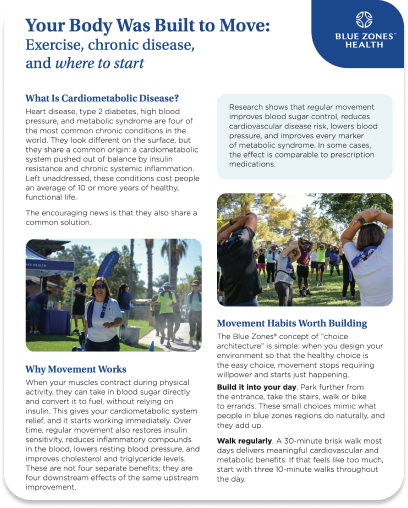
| | | | | | Exercise and Chronic Conditions: Patient Handout |
We've also developed a one-page patient handout on the role of exercise in managing chronic conditions. It addresses one of the barriers your patients likely voice regularly: the sense that a chronic condition makes starting too complicated or risky. It provides a simple, practical framework they can take home.
| | | | | | | | | | Colorectal Cancer Awareness Month | | The American Cancer Society's Colorectal Cancer Statistics, 2026 report, published earlier this month, includes a finding worth incorporating into your patient conversations: colorectal cancer is now the number one cause of cancer-related mortality for adults under 50, and adults younger than 65 now account for 45% of all new diagnoses, up from 27% in 1995. An estimated 158,850 people will be diagnosed in 2026.
Five-year survival for localized colorectal cancer exceeds 91%, compared to 15% for distant-stage disease. Current guidelines recommend screening beginning at age 45 for average-risk adults, yet among 45 to 49-year-olds, the screening rate is only 37%. A provider recommendation remains the single most consistent predictor of whether a patient follows through. Consider making colorectal cancer screening status a routine part of your annual wellness visit workflow for all eligible patients. | | | |
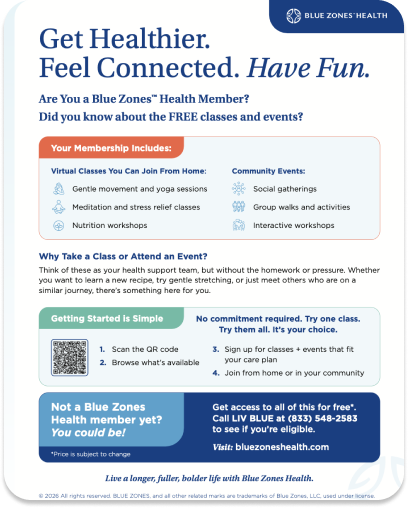
Your Blue Zones Health patients may not know about the free virtual classes and vetted community events available to them as members. This printable flyer makes it easy to spread the word. Display it in your waiting room, pin it to a bulletin board, or tuck it into an acrylic stand wherever patients are likely to see it. It also includes information for patients who aren't yet members and want to find out if they're eligible and how to join.
| | | | | | | | Well-Being Services: Virtual Programs and Community Prescriptions | | Our new Well-Being Services events calendar has launched, where your patients can find both local events and virtual classes led by top-notch expert instructors. This calendar is searchable class category or location, and includes links to register for events. | | | | | | Coding and Quality Corner | | Clinical Documentation Improvement (CDI) Tip: Apply MEAT to Every Chronic Condition
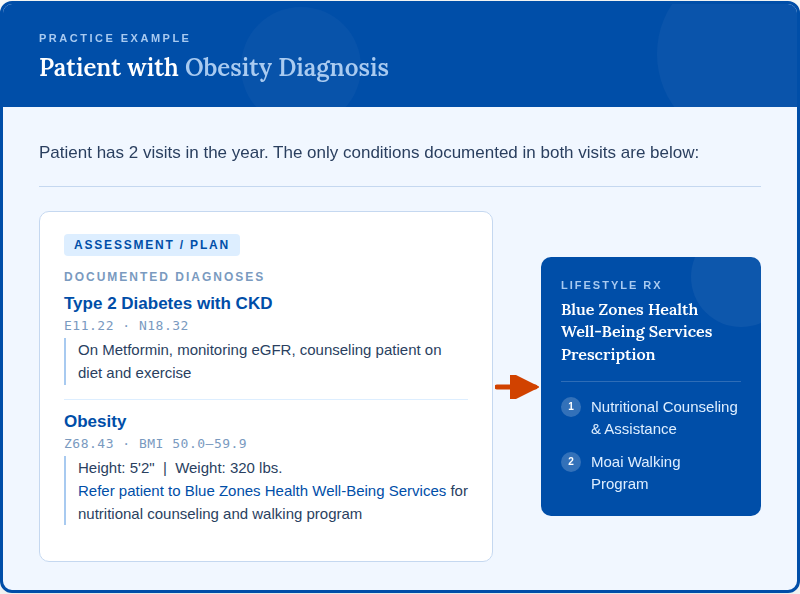
When documenting chronic conditions that are pertinent to a patient's visit, make sure your note supports each diagnosis with MEAT: Monitoring, Evaluation, Assessment, and Treatment. That means bringing the diagnosis into your assessment and plan and documenting the current treatment, the patient's stability status, and your ongoing management approach. If a chronic condition isn't reflected in the note, it effectively doesn't exist for coding purposes, which can affect your patient's access to benefits and services in the coming year.
The example below shows that a patient with a BMI over 35 who is officially documented with an overweight or obesity diagnosis may qualify for nutrition counseling and obesity counseling through Well-Being Services. The diagnosis has to be in the chart for that referral pathway to open.
| | | | | | | | - Consistent physical activity throughout middle adulthood may offer greater protection against chronic disease than high but sporadic activity levels.
A February 2026 study published in Nature Communications followed more than 231,000 adults over 32 years and found that people who maintained physical activity at recommended levels throughout the follow-up period had a 10 to 28% lower incidence of major chronic diseases, including type 2 diabetes, cardiovascular disease, and cancer, after age 60. The authors note that the trajectory of activity, not just the volume at any one point, may be a meaningful target for clinical guidance. - Exercise variety may carry independent mortality benefits beyond total activity volume.
A January 2026 study from Harvard T.H. Chan School of Public Health, published in BMJ Medicine, analyzed data from more than 111,000 adults followed for over 30 years and found that participants who engaged in the highest variety of exercise types had a 19% lower risk of premature death compared to those who engaged in the lowest variety, even after controlling for total physical activity levels. The relationship held at every level of overall activity, suggesting that diversity of movement is a clinically relevant variable independent of how much patients exercise overall. Get the bottom line from Harvard’s press release here. - Objective activity data from wearable devices may provide a more accurate picture of chronic disease risk than self-reported exercise.
A January 2026 study published in Communications Medicine analyzed Fitbit data from more than 15,000 participants (over 9,000 with linked EHRs) in the All of Us Research Program, linking six or more months of continuous activity data with electronic health records. Higher daily activity and lower sedentary time were each independently associated with reduced risk of obesity, diabetes, and other chronic conditions, reinforcing the clinical value of device-based monitoring in risk stratification. - A plant-forward diet is associated with meaningfully reduced risk of developing chronic kidney disease in a large prospective analysis.
A January 2026 study published in the Canadian Medical Association Journal found that adherence to the EAT-Lancet dietary pattern, characterized by high plant food diversity and limited ultra-processed and animal foods, was associated with significantly lower CKD risk. The findings align with a 2025 clinical trial in the Clinical Journal of the American Society of Nephrology, which found that consuming more than 30 different plant foods weekly improved gut microbiome diversity and reduced uremic toxin levels in patients with existing CKD, including those with advanced disease. Get the plain-language news summary here. - A January 2026 review published in Public Health Reports synthesized current evidence on integrating lifestyle medicine into primary care settings.
Among the key findings: more than 80% of heart disease, stroke, and type 2 diabetes cases are potentially preventable through healthier behaviors, yet primary care systems continue to lack structured referral pathways for nutrition counseling, exercise prescription, and behavioral support. The authors call for policy-level investment in infrastructure that makes lifestyle-based care a standard component of chronic disease management rather than an add-on. | | | | | |
Before you go… - Do you know a Blue Zones Health provider who’s doing great work? Let us know! Click here to nominate them as a featured provider!
- Have an announcement to share with the Blue Zones Health provider community? Tell us about it!
- Questions we haven't answered? Call 833-LIV-BLUE
With cheer and good health, The Blue Zones Health team
| | | | Our mailing address is: 4368 Central Ave, Riverside, CA 92506 View in Browser
| | | | | | | |